

The hardest thing about mastery isn’t the climb; it’s the view from the top.
Nobody warns you that the better you get at something, the harder it becomes to learn the next thing. We trade our curiosity for certainty, and our years of experience eventually become the very walls that keep new ideas out.
But what if the most underrated competitive advantage in the modern economy is a 1400-year-old Zen practice?
The Power of Shoshin
The Japanese call it Shoshin. It translates to Beginner’s Mind. Coined by Zen teacher Shunryu Suzuki, it describes a rare posture: approaching the world with radical openness, deep curiosity, and a total absence of preconceptions, no matter how much you think you already know.
"In the beginner's mind there are many possibilities; in the expert's mind there are few."
~ Suzuki
The Half-Life of Expertise
In the last eighteen months, the ground has shifted. The half-life of expertise is collapsing. The frameworks we leaned on are being rewritten in real-time. Old playbooks are being incinerated by tools and systems that didn't exist two years ago.
In this climate, Shoshin has graduated from a nice-to-have philosophy to the only durable advantage left.
Here is the paradox of success: Every win adds to your authority. Every ounce of authority hardens your assumptions. By the time you’ve built something real, admitting "I don't know" feels like a liability.
Case Study: Radical Curiosity
This is why Kari Warberg Block, founder of EarthKind, stands out.
When the entire pest control industry insisted that natural solutions don't work, Kari didn't lean on industry wisdom. She adopted a beginner’s mind and rebuilt the system from the ground up.
The result? The world’s first bio-based, no-kill rodent solution and over $460M in sales driven by truth-telling and radical integrity.
Despite decades of success, Kari refuses to be a settled leader. She is a builder who believes in earning her relevance every single day.
Most recently, she joined the FlipWork Agentic-Leader certification, applying that same Shoshin posture to the world of AI. Kari didn't sign up because she was behind. She showed up because she's a builder. And builders stay curious.
The Beginners Mind
Accomplished leaders share one habit: they never confuse past success with future readiness. That beginner's mind, at any age, at any level of success, is the line in the sand. It separates those who shape the future from those who are shaped by it.
As Suzuki taught: "If your mind is empty, it is always ready for anything; it is open to everything."
Your challenge this week: Empty your mind. Be a beginner on purpose. Become ready for what comes next.

THE SHIFT
Expert Authority → Beginner Curiosity
Research on shoshin shows that people artificially induced to feel like experts on a subject become more rigid, more closed-minded, and less willing to engage with ideas outside their existing frame, compared with people induced to feel like beginners on the same topic. As Jensen Huang reveals: "Confronting our mistake and, with humility, asking for help saved NVIDIA. These traits are the hardest for the brightest and most successful." Expertise does not sit on top of who you are. It shapes how your brain processes new information.
Knowing The Answer → Loving The Question
Jeff Bezos personally drove Amazon's packages to the post office in the early days. Twenty years later, his approach to new domains has not changed: "We seek to hire our tutors." Jensen Huang washed dishes and cleaned bathrooms at Denny's and credits that experience with teaching him a humility he uses to this day. Howard Schultz returned to Starbucks during its decline by approaching the company as if it were Day One again. The pattern is shoshin in action. The greatest builders return to the discomfort of not knowing on purpose, again and again, because the willingness to be a beginner is the asset that compounds across decades.
Earning Your Title → Earning Your Relevance
Your title was a moat. It signaled tenure, expertise, and the right to be in the room. That title is now a label, not a moat. AI has stripped the cost of building so low that solo-founded startups jumped from 24% in 2019 to 36% in 2025. There are 42 million solopreneurs in the US now generating $1.7 trillion in annual revenue. The same collapse is happening inside companies where a 28-year-old with the right AI stack can now outproduce a department of fifteen people. The field has flattened and the only thing protecting relevance is Shoshin: the willingness to be a rookie and learn faster than the field is changing.

THE STRATEGY
Shoshin is a posture you install and repeat until it becomes how you operate. Run this protocol on yourself this week.
Map Your Domains Of Authority
On one page, list the five domains you operate across: your function, your industry, your tools, your network, and your worldview. Rate each from 1 to 5, where 1 means "I am still actively learning here" and 5 means "I have not been a beginner here in over three years." Circle every domain that scored 4 or 5. Those are the places your mind has closed.
Name The Closure
For each circled domain, identify which of three closures applies.
- Identity closure: you stopped learning because being the expert is part of who you are.
- Efficiency closure: you stopped learning because your existing knowledge gets the job done.
- Avoidance closure: you stopped learning because the new thing scares you.
Write the closure type next to each domain. Naming the closure is the first act of shoshin; you cannot empty a cup you do not know is full.
Practice The Opening
Pick the domain with the highest score and match the practice to the closure type.
- For identity closure: Schedule a call with someone younger who knows more about something inside this domain, and ask them to teach you.
- For efficiency closure: Find a recent study that contradicts a position you've held, and write a memo reconciling the gap.
- For avoidance closure: Build something using AI in the avoided domain this week and complete it before Friday.
Each practice is a deliberate emptying of the cup so you can rebuild the posture while producing the output.
Install Your Beginner's Mind Partner
Open Claude or ChatGPT and create a project for the domain you selected. This is a neutral space where you can practice not knowing without social cost: no peers, no team, no judgment. Load it with your role context, your current understanding, and the specific gap you are closing. Use the Shoshin Prompt below to brief it. This is your Beginner's Mind Partner, where you bring the questions you cannot ask anywhere else.
Schedule The Practice
Schedule Shoshin Sessions on your calendar, every quarter. Each session follows the same structure: re-rate the domain, name the new closure, practice the opening, document what shifted. Shoshin is a discipline you return to until it becomes the way you work.
THE STACK
Use this AI prompt and save the conversation as a project. The growth you feel will be in how easily you can return to not knowing.
The Shoshin Prompt
I am a [your role] at a [company stage/size] in the [industry] sector. I have decided to deliberately enter a state of beginner's mind in the domain of [domain].
My current understanding of this domain is [one paragraph; be honest about what you do and do not know].
The closure I am working with is [identity, efficiency, or avoidance]. The specific gap I want to close is [the question you cannot ask in a meeting].
Act as my Beginner's Mind Partner on this domain.
Start by asking me three diagnostic questions to assess where I actually am, and push back when my answers carry hidden expertise masked as questions.
Then teach me the foundational concepts I am missing, in plain language, with concrete examples relevant to my role. Never assume I already know something; make me prove it.
When I am ready to test what I have learned, give me a real-world scenario and grade my response with no flattery.
Our goal is to take me from beginner to confident practitioner in [timeframe], without letting me skip the discomfort of not knowing.
THE SHELF
Beginners: The Joy and Transformative Power of Lifelong Learning
By Tom Vanderbilt
In his late forties, journalist Tom Vanderbilt watched his young daughter learn chess and realized he had not been a true beginner at anything in over twenty years. So he made himself one. Over the course of a year, he took up chess, singing, surfing, drawing, and juggling, and documented what it felt like to be terrible at something as an accomplished adult. The result is the most honest book I've read on the lived experience of shoshin.
THE SIGNAL
The Only Constant Podcast
By Lasse Rindom
I sat down with Lasse Rindom for one of the most personal conversations I have had this year. We talked about cognitive atrophy as the real danger of the AI age, and why reinvention is the only constant.
|
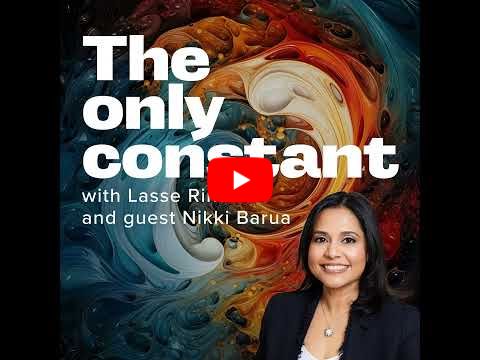
In this episode, I share the key ingredients for reinvention:
- Curiosity: You have to be deeply curious to see what change is happening, where the world is headed, and what it demands of you. Curiosity presents an opportunity of become the next version of you.
- Humility: It takes an extreme level of humility to go from being the expert to becoming a rookie again. You can't reinvent if you're still holding on to the titles, the labels, the earned credentials. Humility allows new knowledge and new growth to emerge.
- Bravery: You have to exist in that in-between space of nothingness, where you are nothing, you have become nothing, you have created nothing yet. It takes bravery to step into that unknown, be in that uncertainty, take on that risk, and be completely bare.
What comes out of that humility, that curiosity, and that bravery is a version of you that can change the world.
What would you be willing to learn if no one were watching you learn it?
Until next time...stay curious!
Cheers,
Nikki
PS: If this sparked something, reply back or share it on LinkedIn. These conversations matter.
